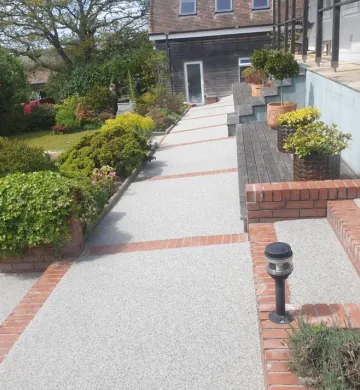
A garden path takes more of a beating than most people expect, which is why so many West Country homeowners now choose resin pathway surfacing. A path is walked on every day, rained on for much of the year, and hemmed in by borders, lawns and beds that never stop growing. Across Devon, Cornwall, Somerset and Dorset, where the weather stays damp and mild, loose gravel scatters into the flowerbeds and traditional paving slabs green up with algae and sprout weeds within a season or two.
So which surface stays smart, safe and low-maintenance through a full year? For a growing number of homeowners, the answer is resin. The same resin bound system behind our resin driveway surfacing and our resin bound patios works just as well on a garden path.
A resin bound pathway gives you a smooth, seamless, permeable finish that drains freely, resists weeds and holds its colour for years, with a full range of resin colours to choose from.
Below are seven reasons a resin path outperforms gravel and block paving, plus honest answers to the questions we are asked most often.
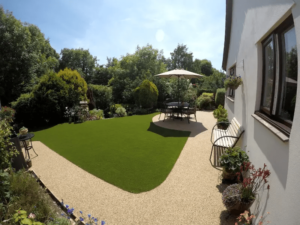
Resin bound surfacing is a mix of natural aggregate and clear resin, trowelled onto a prepared base to form a single, continuous surface with no joints and no loose stones. That simple difference is what makes it so well suited to garden paths: nothing to migrate, nothing to lift, and nowhere obvious for weeds to take hold. It looks considered and cared for from the moment it cures, and it keeps that finish with very little effort from you.

Gravel shifts underfoot and paving relies on dozens of joints that never quite stay level. A resin path is laid as one continuous surface, so it looks clean from the road and stays comfortable to walk, wheel a barrow over, or push a pram along.
A resin bound path lets rainwater drain straight through it into the sub-base rather than running off. That qualifies it as a permeable surface under Sustainable Drainage Systems (SuDS) guidance, which matters in our high-rainfall corner of the country and usually means no standing water after a downpour.
The textured aggregate gives natural grip, so a resin path stays reassuringly non-slip even when wet. For shaded or coastal gardens that rarely dry out fully, that grip is one of the biggest day-to-day advantages over smooth, sealed slabs.
With no joints or gaps, there is nowhere for weeds to root and far less chance of moss taking hold. An occasional sweep and the odd rinse keeps it looking sharp, and our guide on Battling Moss & Algae on Resin Driveways covers the simple routine that keeps any resin surface fresh.
Unlike loose gravel, a bound surface stays exactly where it is laid. There are no stones to kick into the lawn, jam a mower, or wash away on a slope, and no lifted edges to catch a toe.
Resin comes in a broad range of aggregate blends, from soft natural golds and greys to darker, more contemporary tones. You can pick a blend that complements your planting, your patio and the stone of your home, and even define borders or edges for a designed-in look.
A properly installed resin bound path typically lasts 15 to 25 years with light upkeep. It copes with constant foot traffic, garden furniture and the freeze-thaw of a South West winter without cracking or fading like cheaper surfaces tend to.

Gravel is cheap to lay but high-effort to live with: it scatters, thins out, needs topping up, and gives weeds an easy home. Block paving looks smart initially but relies on jointing sand that washes out over time, leaving gaps for weeds and blocks that work loose and trip you up. Resin sits between the two on cost and comfortably ahead on finish and upkeep, giving you the clean look of paving without the joints and the free drainage of gravel without the mess.
From a simple side-return path to a sweeping garden walkway, resin adapts to almost any shape and setting. Here are a few completed pathways from around the South West to spark some ideas.


A pathway rarely sits on its own. Finishing your path, patio and driveway in the same resin blend gives the whole property a designed-as-one look that flows from the front gate to the back garden. If your garden includes a pool, the same seamless, slip-resistant finish is ideal for resin swimming pool surfacing too.
We have spent more than three decades installing resin surfaces across Devon, Cornwall, Somerset and Dorset, and the experience shows in the detail of every path we lay.
Thinking about a new garden path? The easiest next step is a free site survey. We will measure up, check the existing ground, talk through colour and finish options, and give you a clear written quote with no pressure.
Call us on 01626 248768 or email hello@resindrivewayexperts.co.uk. We work across Devon, Cornwall, Somerset and Dorset.
A properly installed resin bound pathway typically lasts 15 to 25 years with routine cleaning and the occasional reseal. The finished quality depends far more on the installer and the base preparation than on the resin brand itself.
Cost depends on the size of the path, access, and the condition of the existing ground, since a sound base can often be worked with while a poor one needs building up first. The most accurate way to get a figure is a free site survey, where we measure up and give you a written quote.
No. The textured aggregate gives natural grip and the surface is designed to be non-slip, which is one of the reasons it suits shaded and coastal gardens that stay damp for much of the year.
Often, yes. Sound concrete or tarmac can be used as a base with the right preparation and priming, which keeps disruption and cost down. We confirm whether your existing surface is suitable during the survey.
In most cases no, because resin bound is a permeable surface. There are exceptions for listed buildings and conservation areas, which we can check for you before any work begins.