
Before you park anything heavier than the family car on a new driveway, it is worth knowing exactly what the surface can take, which is why so many homeowners ask us about resin driveway surfacing and weight before they commit. The short version: a correctly specified resin bound driveway comfortably handles everyday cars and vans, and with the right base it can take a good deal more.
For most households that means a couple of cars, the occasional delivery van and a visiting motorhome are no problem at all. Where loads get heavier or more frequent, such as regular commercial traffic, the specification simply steps up, which is where our commercial resin surfacing comes in.
Across Devon, Cornwall, Somerset and Dorset we build driveways that stay stable under axles, drain freely through our wet winters, and wipe clean when salt or oil gets on them, with our resin cleaning service on hand if a surface ever needs a proper refresh. Here is what a resin driveway can really carry, and how to get the spec right.

As a rule of thumb, a correctly installed resin bound driveway laid at 18mm to 20mm over a properly prepared base can typically carry up to around 7.5 tonnes. To put that in perspective, an average family car weighs about 1.4 tonnes and a large van around 3.5 tonnes, so a domestic driveway has a comfortable margin for normal use.
The figure that matters is not just the resin, though. The weight is carried by the whole build-up, and the surface layer is only the final few millimetres of it.
The single biggest factor in how much a resin driveway can take is the sub-base beneath it. For vehicle use we lay a deep, well-compacted MOT stone sub-base, then the resin bound layer on top at the correct depth. Get the base right and the surface spreads the load evenly; skimp on it and even a light car will eventually cause depressions, whatever resin sits on top.
This is also why installer choice matters more than the brand of resin. A shallow or poorly compacted base is the number one reason resin surfaces fail early under weight.
For a domestic driveway built to the right spec, all of the following are fine for normal use:
The thing to watch is not total weight so much as concentrated point loads: caravan corner steadies, jockey wheels and trailer jacks put a lot of force through a small area. A spreader pad under each foot protects the surface, and we will always talk through how you will use the driveway during the survey.

If you regularly turn or park genuinely heavy vehicles, or the driveway doubles as commercial access, the answer is not to avoid resin but to build it to suit. That means a deeper reinforced sub-base and careful attention to drainage and edging so the surface stays put under repeated heavy loads. It is exactly the kind of build we specify for commercial sites.
Resin bound is low maintenance, but heavy-use driveways benefit from a little care. Rinse off salt, sap and oil promptly, use spreader pads under point loads, and keep the surface swept. Damp West Country conditions also encourage moss on any surface, and our guide on Battling Moss & Algae on Resin Driveways covers the simple routine that keeps a driveway looking sharp.
Tarmac copes with weight but can soften in summer heat and scuff under turning wheels. Block paving carries load well but relies on jointing sand that washes out, leaving blocks to work loose and rut under repeated use. A correctly specified resin bound driveway gives you the load capacity of a solid surface with a seamless, permeable, low-maintenance finish and no joints for weeds to exploit.
A hard-wearing driveway does not have to look industrial. There is a wide choice of aggregate blends and colours to suit your home, which you can explore on our resin colours page. Here are a few completed driveways from around the South West.


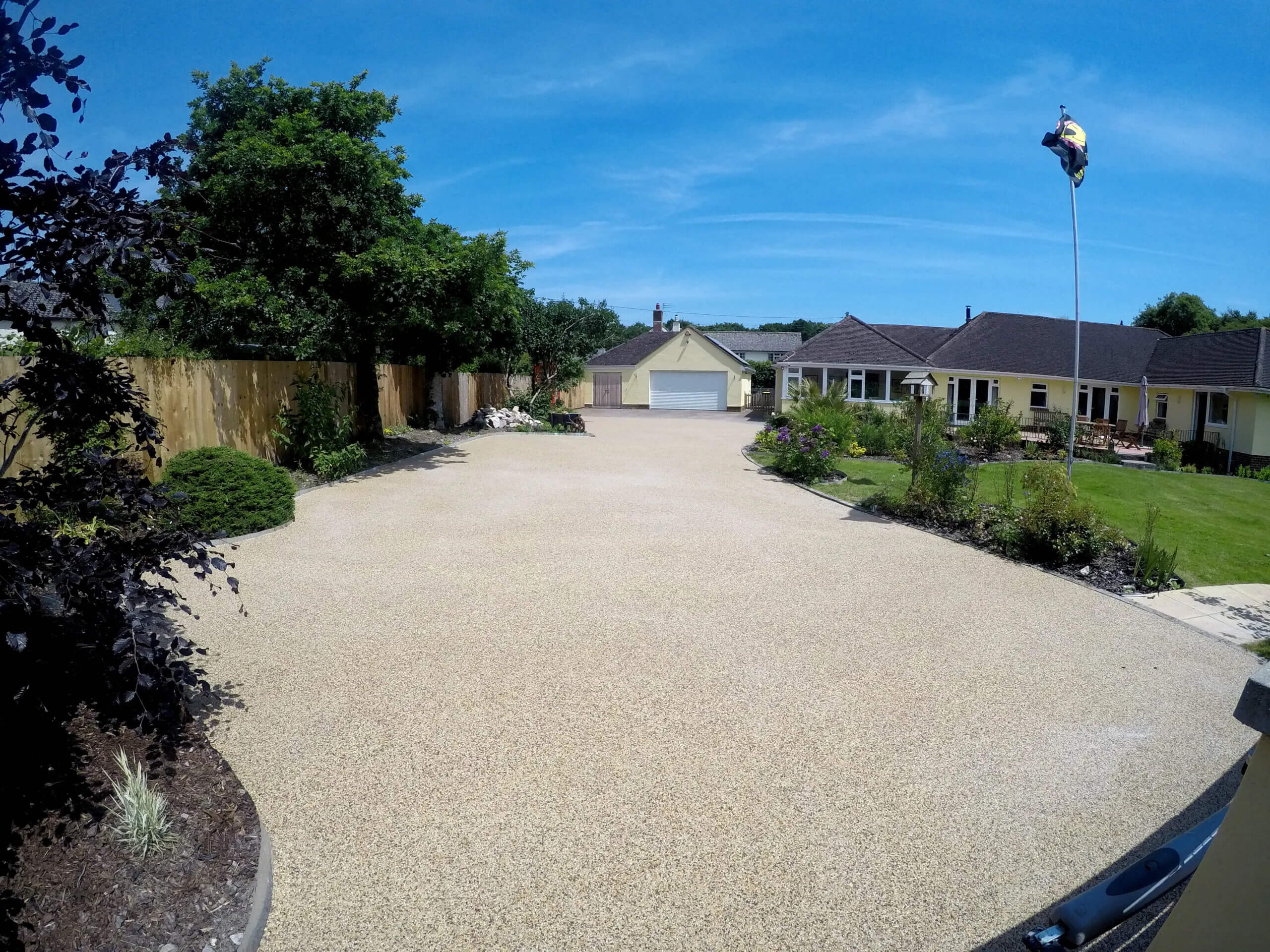


We have spent more than three decades installing resin surfaces across Devon, Cornwall, Somerset and Dorset, and it shows in how our driveways hold up under real-world use. A well-built driveway also protects your home’s value, as we explain in Do Resin Driveways Add Value to Your Home?
Not sure whether your driveway can take the weight you have in mind? The easiest next step is a free site survey. We will check the existing ground, discuss how you will use the driveway, and give you a clear written recommendation and quote with no pressure.
Call us on 01626 248768 or email hello@resindrivewayexperts.co.uk.
A correctly installed resin bound driveway at 18mm to 20mm over a properly prepared sub-base can typically carry up to around 7.5 tonnes. Since an average car is about 1.4 tonnes and a large van around 3.5 tonnes, a domestic driveway has plenty of margin for everyday use.
There is no single fixed limit, because capacity depends on the depth and quality of the sub-base as much as the resin layer. A domestic spec suits cars, vans and motorhomes; heavier or commercial use simply needs a deeper, reinforced build.
A properly specified resin bound driveway is an excellent choice, giving strong load capacity with a seamless, permeable, low-maintenance finish. The key is getting the sub-base depth and compaction right for the loads you expect.
Yes. The main thing to manage is point loading from corner steadies and jockey wheels, so we recommend spreader pads under the feet. The overall weight of a caravan or motorhome is well within a correctly built driveway’s capacity.
Not when built correctly. Cracking and depressions almost always trace back to an inadequate sub-base rather than the resin itself, which is why professional installation and proper ground preparation matter so much.