
Weeds pushing up through your resin driveway surfacing, or through the block paving or gravel it replaced, are unsightly, they damage the surface over time, and they often come back despite repeated treatments. Across Devon, Cornwall, Somerset and Dorset, frequent rain, windblown seed and damp conditions make the problem worse, moss, seedlings and persistent perennial roots find any crack or open joint and take hold.
This guide explains why weeds get through in the first place, what a correctly installed resin surface does differently, and the routine care that keeps a driveway weed free for years.
Understanding how weeds get a foothold helps you choose the right fix. The most common causes are not the seed itself, but weaknesses in the construction and ongoing surface management.
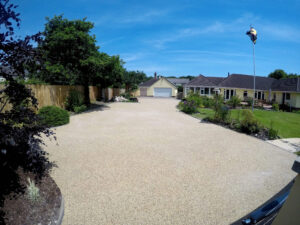
Resin bound surfacing combines kiln-dried aggregates with a clear polymer binder, trowelled onto a prepared base to create a single continuous, permeable finish. That construction makes a real difference to weed growth.
The same principles apply to resin pathway surfacing and resin bound patios, both are just as prone to weeds as a driveway if they are laid with open joints, and just as resistant when they are not.
If your current driveway already has recurring weed problems, you do not always need to start from scratch. A professionally applied resin overlay can bond to many existing sound bases, eliminating the open joints where weeds take hold and creating a continuous, permeable surface in their place. Where the subbase itself is compromised, excavating and rebuilding it properly is the only lasting fix, patching the surface alone will not stop regrowth if the structure underneath is the real problem.
It is worth checking the same detailing around resin swimming pool surfacing and resin balcony surfacing too, since damp, shaded edges in these areas can be just as prone to moss and weed growth if the joints are not properly closed.

Once you have a sound resin surface, simple regular tasks keep weeds at bay and prolong its life.

Call us if any of the following describe your driveway: persistent regrowth where repeated DIY treatments keep failing, visible cracking or edge movement suggesting the subbase needs attention, or general staining and surface wear that a clean or colour-matched repair would fix. From our base in Newton Abbot, we carry out site inspections across Devon, Cornwall, Somerset and Dorset, including regularly in Exeter, Torquay and Truro, advise the least invasive fix, and provide a clear schedule showing the work stages involved.
Here are a few recent resin driveways installed across the South West, all built with a proper subbase to keep weeds out for good. Choosing from our resin colours range has no bearing on weed resistance at all, so that decision can be made purely on how you want the finish to look.


If weeds keep coming back through your driveway, patio or pathway, get in touch with Resin Driveway Experts on 01626 248768 or hello@resindrivewayexperts.co.uk. We carry out free, no-obligation surveys across Devon, Cornwall, Somerset and Dorset, and every installation is backed by our 10-year guarantee.
Treating the weeds themselves only ever offers a temporary fix. Permanent results come from removing the structural weaknesses that let them grow, closing open joints, rebuilding a poor subbase, and installing a continuous, permeable surface such as resin bound surfacing that gives weeds nowhere to take hold.
The main pitfall is a poorly prepared installation. If the subbase is not properly compacted or the resin is laid too thin, problems like cracking, pooling or even weed growth can appear over time. This is why professional installation and a proper guarantee matter far more than the resin material itself.
A correctly installed resin bound driveway is built to last for many years with only routine care, which is why we back every installation with a 10-year guarantee.
Not typically, provided the surface is laid over a proper subbase with no open joints. Occasional windblown seed can settle on top and germinate in surface debris, but regular sweeping prevents this, and it is a very different problem to roots pushing up from below.